Add your promotional text...
Understanding the W Model in Pharmaceutical Validation and Qualification
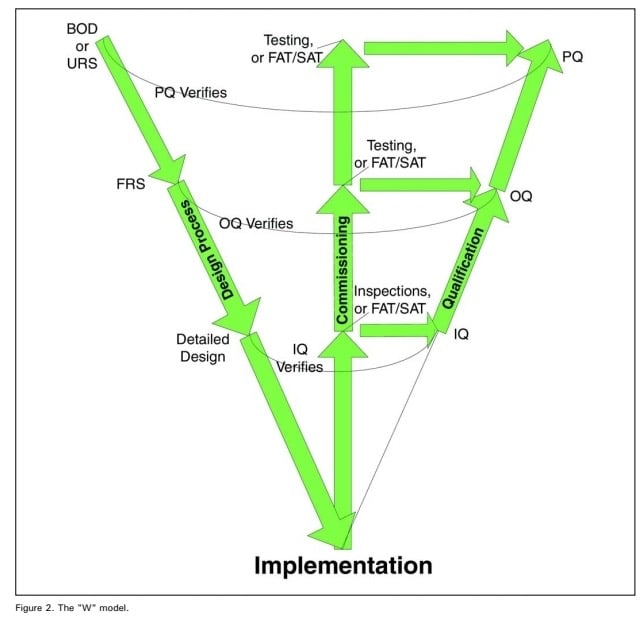
The “W Model” of Commissioning & Qualification (C&Q) is an evolution of the traditional “V Model,” designed to better integrate commissioning activities with qualification and validation in pharmaceutical and biotech projects. It emphasizes a risk-based, science-driven approach where commissioning and qualification are not sequential but interwoven, forming a “W” lifecycle structure.
COMMISSIONING AND QUALIFICATION
PharmaGyan
5/19/20267 min read
Introduction to Validation and Qualification
In the pharmaceutical industry, validation and qualification are integral processes that ensure the safety, efficacy, and regulatory compliance of products. Validation refers to the process of demonstrating that a particular method, process, or system consistently produces a result that meets predetermined specifications and quality attributes. This process is essential in substantiating the quality of pharmaceutical products.
Qualification is a subset of validation and involves the assessment of specific facilities, equipment, and systems to confirm that they are suitable for their intended use. Qualification ensures that all necessary operational parameters are met, thus guaranteeing that equipment performs reliably and safely throughout its lifespan.
The significance of both validation and qualification in the pharmaceutical sector cannot be overstated. They play a crucial role in the regulatory framework that governs the industry, such as the regulations set forth by the U.S. Food and Drug Administration (FDA) and the European Medicines Agency (EMA). These agencies require extensive documentation that illustrates the validation processes employed during manufacturing, allowing for oversight and assurance that products are consistently safe for public consumption.
Furthermore, the integration of validation and qualification into the pharmaceutical development process helps prevent issues that may arise during later stages of production, reducing the risk of product failures, recalls, or potential harm to patients. Establishing a robust validation and qualification regimen not only fosters compliance with regulatory guidelines but also builds consumer trust in pharmaceutical products.
Thus, validation and qualification are foundational components of a quality assurance strategy in the pharmaceutical industry, underscoring the commitment of manufacturers to maintain high standards in product development and production.
Overview of the W Model
The W Model is a structured approach used primarily in the realm of pharmaceutical validation and qualification. Its design aims to enhance the understanding of how processes in the pharmaceutical industry should be aligned with regulatory requirements and productivity benchmarks. The model illustrates a holistic view of the validation lifecycle, providing insights into how these processes interlink and evolve over time.
Visually, the W Model resembles the letter "W," which highlights its two primary phases: the initial phase represents the planning and execution of validation processes, while the descending part of the “W” denotes the assessment of the obtained results against predefined acceptance criteria. Following the evaluation, the model suggests iterations if results do not meet expectations, thus emphasizing the importance of continuous improvement and adaptability in validation practices.
An essential characteristic of the W Model is its focus on integrating risk management throughout the validation process. This approach allows for prioritization based on the potential impact of various processes on product quality and safety. By systematically addressing areas of higher risk, pharmaceutical companies can allocate resources effectively, ensuring that critical aspects of validation are given appropriate attention.
The applicability of the W Model extends beyond mere compliance; it fosters a culture of excellence and reliability within the industry. Companies adopting this model not only meet regulatory standards but also enhance operational efficiency and product quality. Thus, understanding the W Model is crucial for professionals involved in pharmaceutical validation and qualification, as it provides a comprehensive framework that guides them toward successful outcomes.
Key Features of the W Model
The W Model is an innovative approach to validation and qualification that distinguishes itself from other methodologies through several key features. Foremost among these is its dual-path approach, which integrates both the design and operational phases into a cohesive validation framework. This feature enables project teams to evaluate both the initial conceptualization and the subsequent execution of processes simultaneously, ensuring that validation is comprehensive and aligned with regulatory expectations.
Another significant aspect of the W Model is its emphasis on risk assessment throughout the validation lifecycle. By prioritizing risk management, the model facilitates a more proactive identification of potential issues that could impact product quality and compliance. This risk-centric perspective allows teams to allocate resources effectively, focusing on high-risk areas while streamlining efforts in lower-risk segments. Consequently, the W Model not only enhances the robustness of validation practices but also optimizes workflow efficiency.
Moreover, stakeholder involvement is a critical element unique to the W Model. The framework encourages active engagement from various stakeholders, including researchers, quality assurance personnel, and regulatory bodies. By fostering collaboration among these diverse groups, the model promotes a shared understanding of validation requirements and objectives, which is crucial for achieving successful outcomes. Engaging stakeholders early in the process also ensures that their insights and concerns are integrated, facilitating smoother transitions through each phase of validation.
In conclusion, the distinctive features of the W Model—such as its dual-path approach, focus on risk assessment, and stakeholder involvement—set it apart from traditional validation methodologies. These elements contribute to its effectiveness in ensuring regulatory compliance and product integrity in the pharmaceutical industry.
Application of the W Model in Pharmaceutical Processes
The W Model forms a crucial aspect of pharmaceutical validation and qualification, particularly in enhancing the overall quality and compliance of pharmaceutical products. This model emphasizes the interconnectivity of various validation processes, leading to a comprehensive validation approach. In the context of equipment validation, the W Model is employed to ensure that each piece of equipment used in pharmaceutical production operates within predetermined parameters, thereby minimizing the risk of contamination or error. By continuously validating the operational capabilities of these critical assets, manufacturers can achieve a consistent output that meets regulatory standards.
Moreover, the utility of the W Model extends into process validation, where it aids in the systematic evaluation of manufacturing processes to ensure that products consistently meet their intended quality attributes. The model advocates for a thorough understanding of the process from the outset, allowing for adjustments and refinements necessary for product integrity. This proactive approach often results in decreased variability and improved reproducibility of pharmaceutical products, which are vital in maintaining market trust and regulatory compliance.
Analytical method validation, another significant application of the W Model, ensures that the methodologies employed in testing the quality of pharmaceutical products are reliable and accurate. In this phase, the model promotes a structured framework for validating and qualifying analytical techniques. For example, case studies demonstrate how the implementation of the W Model has led to enhanced precision in measurement and reduced errors in results interpretation. By aligning validation strategies with the W Model, pharmaceutical companies not only comply with industry regulations but also foster a culture of continuous improvement and sustainability.
Benefits of Using the W Model
The W model presents several significant advantages in the realm of pharmaceutical validation and qualification processes. Firstly, one of the most prominent benefits of employing the W model is the improvement it brings in compliance with regulatory standards. By structuring the validation process into clear, logical stages, organizations can ensure that each phase meets relevant regulatory requirements. This systematic approach not only helps in creating a robust validation process but also streamlines the documentation necessary for compliance audits, thus reducing the risk of non-compliance.
Another key benefit of utilizing the W model lies in its contributions to increased efficiency. Traditional validation methods often involve a linear process that can be time-consuming and prone to errors. In contrast, the W model allows for simultaneous activities and feedback loops throughout the validation lifecycle. This interactivity significantly shortens the overall validation time while minimizing delays in bringing pharmaceutical products to market. By fostering an environment of continuous improvement, the W model enhances operational efficiency and promotes a proactive approach to validation.
Moreover, the enhanced risk management capabilities embedded in the W model further underscore its advantages. By identifying potential risks at various stages of the validation process, organizations can deploy mitigation strategies early on, which is crucial in the highly regulated pharmaceutical industry. The iterative nature of the W model facilitates ongoing assessment and adjustment, thereby strengthening the organization’s ability to respond to unexpected challenges. Overall, the integration of a strategic approach to risk management not only protects product integrity but also supports organizational resilience.
Challenges and Limitations of the W Model
The W Model, while a favored approach in pharmaceutical validation and qualification, faces several challenges that can hinder its effectiveness. One primary issue is the potential for misapplication of the model. In scenarios where the W Model is not implemented correctly, it can lead to inaccurate results and validation outcomes. This is particularly concerning in a sector that prioritizes compliance and precise validation processes. Misunderstandings regarding the model's framework can result in the failure to meet critical quality attributes, thereby raising concerns about patient safety.
Additionally, the W Model often relies heavily on subjective assessments, which can introduce variability into the validation process. Subjectivity in measurements and evaluations can lead to discrepancies among different evaluators. Each evaluator may have unique interpretations of the guidelines, affecting the consistency and reproducibility of validation results. Such variability can undermine the model's intended reliability and diminish confidence in the outcomes achieved through its application.
Furthermore, the W Model may encounter limitations concerning flexibility and adaptability to new regulatory requirements and technologies. As the pharmaceutical landscape evolves and new challenges arise, adaptations to the model may be necessary. However, the inherent structure of the W Model can make it cumbersome to modify without compromising essential elements of the validation process.
In light of these challenges, it becomes essential for pharmaceutical companies to ensure thorough training and clear guidance on the proper application of the W Model. By fostering deeper understanding among stakeholders and minimizing subjectivity, organizations can enhance the validation outcomes derived from this model while addressing its limitations effectively.
Conclusion and Future Perspectives
The W Model has emerged as a pivotal framework in the field of pharmaceutical validation and qualification, providing a structured approach that ensures the efficacy, safety, and compliance of pharmaceutical products throughout their lifecycle. By emphasizing a comprehensive validation strategy, the W Model facilitates a more intuitive understanding of the interplay between risk management and the qualification of various processes and systems. This model not only enhances clarity but also promotes consistency in validating both equipment and software, ultimately leading to improved product quality and regulatory compliance.
As the pharmaceutical industry evolves, the future of validation methodologies promises to embrace more advanced technological solutions, such as automation and artificial intelligence. These advancements could potentially streamline processes and enhance the precision involved in qualification activities. Additionally, the integration of real-time data analytics may further refine the validation processes outlined in the W Model, enabling organizations to preemptively address quality issues before they arise.
Moreover, as regulatory bodies adapt to the rapid pace of innovation, there will likely be a continued alignment of the W Model with emerging guidelines and standards. The model’s flexibility allows for adaptation in accordance with future regulatory trends. Furthermore, the emphasis on continual improvement and lifecycle management in validation practices will be vital as pharmaceutical companies seek to optimize their operational efficiencies.
In conclusion, the W Model stands as a significant contributor to shaping rigorous validation protocols in the pharmaceutical sector. Its future trajectory will likely be influenced by technological advancements and evolving regulatory landscapes, highlighting the necessity for ongoing research and adaptation within validation methodologies.