

Introduction
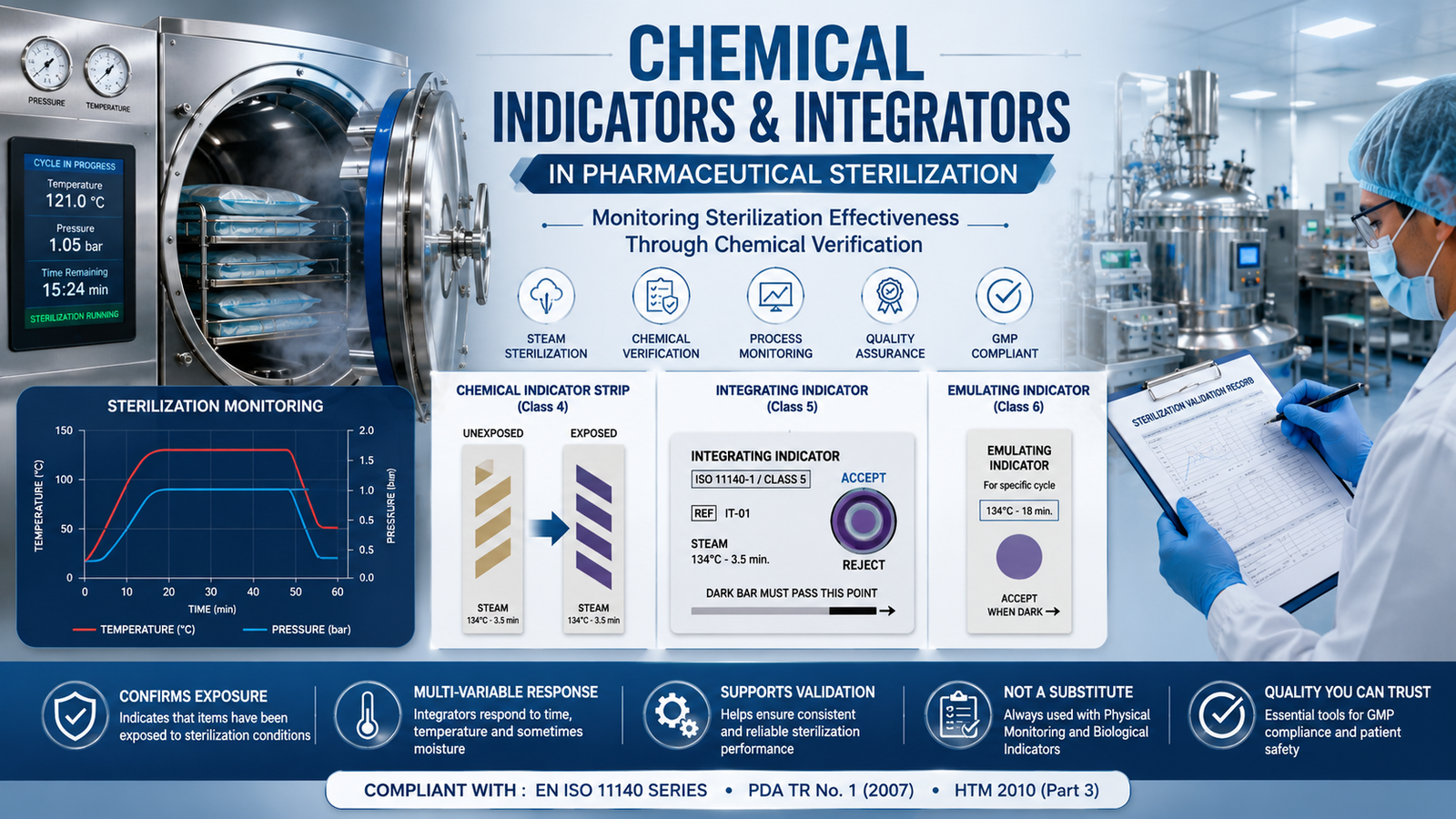
Sterilization is one of the most critical processes in pharmaceutical manufacturing, ensuring that products, equipment, and components are free from viable microorganisms. To verify that sterilization conditions have been achieved, various monitoring tools are used, including Chemical Indicators (CIs) and Chemical Integrators.
While these tools provide valuable information about exposure to sterilization conditions, they do not independently confirm sterility. Understanding their functions, classifications, advantages, and limitations is essential for maintaining compliance with regulatory requirements and Good Manufacturing Practices (GMP).
What is a Chemical Indicator?
A Chemical Indicator (CI) is a device that responds to one or more sterilization process parameters in a non-quantitative manner.
Key Characteristics of Chemical Indicators
- Chemical indicators provide immediate visual results, usually through a color change.
- They serve as a permanent marker indicating that an item has been exposed to a sterilization cycle.
- They do not confirm that the load is sterile.
- They only indicate that certain sterilization conditions, such as a threshold temperature, were achieved.
- Chemical indicators do not reveal the highest temperature reached or the duration for which the temperature was maintained.
- Multiple indicators should be distributed throughout the load to prevent accidental mixing of sterilized and non-sterilized items.
- Available in various forms including tapes, paper strips, labels, and ampoules.
What is a Chemical Integrator?
A Chemical Integrator is a specialized chemical monitoring device designed to react quantitatively to a specific combination of sterilization parameters, typically temperature and time, and in some cases moisture.
Key Characteristics of Chemical Integrators
- Respond quantitatively to critical sterilization parameters.
- Provide a measurable indication of exposure to sterilization conditions.
- Offer results that can be correlated with microbial inactivation.
- Designed to simulate the response of biological indicators more closely than standard chemical indicators.
Advantages of Chemical Integrators
- Some integrators monitor moisture simultaneously with temperature and time.
- Provide additional information regarding sterilization conditions achieved during the cycle.
- Help assess whether sterilizing conditions were uniformly achieved throughout the load.
- Can be correlated with temperature distribution data generated during cycle validation studies.
Limitations of Chemical Integrators
- Cannot replace physical monitoring systems such as temperature and pressure recording devices.
- Cannot replace Biological Indicators (BIs).
- Should never be used as the sole method for sterilization cycle qualification or validation.
Types of Chemical Indicators (EN ISO 11140-1 Classification)
The EN ISO 11140-1 standard classifies chemical indicators into six categories based on their intended application and performance characteristics.
Class 1 – Process Indicators
These indicators distinguish processed items from unprocessed items.
Examples:
- Autoclave indicator tape
- External sterilization labels
Purpose:
- Visual confirmation that an item has passed through a sterilization process.
Class 2 – Specific Test Indicators
Designed for specific equipment performance tests.
Example:
- Bowie-Dick Test Pack
Purpose:
- Evaluates air removal efficiency and steam penetration in pre-vacuum sterilizers.
Class 3 – Single Variable Indicators
Respond to only one critical sterilization parameter.
Example:
- Chemical pellet that melts at a specific temperature.
Purpose:
- Confirms achievement of a single sterilization variable.
Class 4 – Multi-Variable Indicators
React to two or more critical sterilization parameters.
Examples:
- Internal pack monitoring strips
- Printed indicator strips
Purpose:
- Used for internal package control and monitoring.
Class 5 – Integrating Indicators
React to all critical sterilization variables and are designed to correlate closely with biological indicator performance.
Key Features:
- Considered the most accurate internal chemical indicators.
- Monitor the combined effects of time, temperature, and steam quality.
- Widely used for routine pack control monitoring.
Class 6 – Emulating Indicators
Cycle-specific indicators designed to react to all critical variables for a defined sterilization cycle.
Purpose:
- Provide precise monitoring for specific cycle parameters such as temperature and exposure time.
Applications of Chemical Indicators and Integrators
Chemical Indicators and Integrators are commonly used for:
- Routine pack monitoring
- Load monitoring during sterilization cycles
- Identifying sterilizer malfunctions
- Verification of sterilization process exposure
- Preventing mix-ups between sterilized and non-sterilized materials
- Supporting quality assurance and compliance programs
Important Considerations
Chemical Indicators and Integrators are supplementary monitoring tools and should always be used alongside:
- Physical monitoring data (temperature, pressure, and time records)
- Biological Indicators (BIs)
- Validated sterilization cycle parameters
They should never be used as the sole evidence of sterility assurance or cycle qualification.
Regulatory Guidelines and References
1. PDA Technical Report No. 1 (2007)
- Chemical Indicators: Section 3.2.2.1 (Page 16)
- Chemical Integrators: Section 3.2.2.2 (Page 17)
2. HTM 2010 – Part 3
- Chemical Indicator guidance available in Sections 7.36 to 7.42
- Refer to Pages 48–49
3. EN ISO 11140 Series
The primary international standard governing:
- General requirements for chemical indicators
- Classification of indicator types
- Performance requirements
- Test methodologies
Conclusion
Chemical Indicators and Chemical Integrators play a vital role in pharmaceutical sterilization monitoring. While Chemical Indicators provide visual confirmation of process exposure, Chemical Integrators offer a more advanced assessment by responding to multiple critical sterilization parameters. However, neither can independently confirm sterility. Effective sterilization assurance requires a combination of physical monitoring, biological indicators, validated cycles, and regulatory compliance to ensure product safety and quality.
Leave a Reply